19
Jul
Miss J. VanderHoof was one of two agents from the Federal Bureau of Time Modification to be selected for the assignment which was set to occur at exactly 33 seconds past nautical sunset in the lakeside tourist town of St. Marquette inside Uncle Ducky’s on 1st Avenue and Alabama St, a mere thirteen seconds from now, timing being so important due to the unfortunate consequences of spending much of it outside of the regular timeline of human life: those consequences being accelerated aging; minutes turn to years; the skin sags around the eyes and belly fat gets concentrated in unappealing areas; hair thins and grays; some men lose it altogether; women grow infertile and men find them increasingly shrill; Agent Foster, may he rest in peace, got caught in traffic on the exit route and never came home. It was risky work in terms of personal well-being but it paid enough for Miss VanderHoof to retire at 60 (given current inflation and market trajectory), a milestone (retirement) she no longer viewed with the exponential possibility of youth due to the tremendous weight of stress on her everyday life. J—— was 30-something and looking the prime of her professional existence face-to-face and not really trying to think about the possibility that a professional blunder could put her dramatically closer to middle age than 30, the image of which, in today’s culture, was enough to kill a girl.
Julie, Jules, Jane, whatever her name was, she was a time-traveling agent. Her job was to reverse the course of history by altering the details of the past. Current mission: prevent Maverick MacArthur from making love to a complete stranger. The reasoning behind such an MO? Mr. MacArthur just happened to produce the offspring that started World War III. The ironic part of post-abortion America is that murder happens every day when you can see the future to the exact moment of conception with the precision of plus or minus two thrusts. The child, who in an unaltered timeline would commit horrific war crimes against his own people, was sentenced by a court of life-appointed, mostly conservative judges, never to be born in the first place. Three seconds to transport.
The work was unpleasant, nerve-wracking mostly, as there was no room for error, given that the logistics of time travel were still intrinsically complicated, human trial data was understandably scarce, and case studies from mishaps were usually absent due to mistakes that regrettably swallowed entire teams in time tsunamis. J’s boss was also kind of a dick. He gave off the impression that whatever mistakes were made were never going to be his fault, simply a matter of poor timing and bad coincidence. He also loved to second-guess her work during the debrief but would never suggest any of those improvements BEFORE she went to work. That along with his tactless wandering eyes, which loved to scan her backside in the head-to-toe creepy gaze men of the pre-time-travelling-generation did, (and unfortunately continued to do in certain male-dominated industries despite the cultural shifts in workplace harassment that had happened over the last 150 years) were the rational reasons she wanted out. Agent J’s boss looked at his analog watch and started the launch sequence with a passcode J—— was 90% sure ended in 1-2-3-4. She swallowed deeply.
She was unceremoniously transported to 2016—the year Maverick MacArthur conceived the offspring that subsequently went on to found the political party that sank the United States government through intentional budget mismanagement, dismantling institutions, lack of shame and a wanton view of American history, leading to the Chinese recovering the formerly united States’ nuclear arsenal and deciding to send them all on a mission to Mars, quite literally, except due to financial re-appropriations certain federal facilities had fallen in disrepair including the bunkers that housed America’s nuclear stockpile and so instead of shot into space there was a dud too many and it ignited a chain-reaction wildfire that swallowed America’s West Coast in a plume of radiation—during a historic drought—decimating the hopes that human beings as a species could survive on their own planet, which was enough to invoke a literal World War Z because that was the war that ended it capital ‘A’, All.
Despite the high stakes, per Bureau procedure, the interaction was to be as minimal as possible so as not to produce waves of alteration in the time landscape. Agent J hadn’t been a part of any team that accidentally set off a time avalanche but one of her boot camp roommates had broken the nose of a Conceptør during an off-script altercation and the Maldives disappeared for a century.
These also being the early years of time travel and it being a publicly funded endeavor due to its astronomical cost and it having risen from rampant rogue Defense Department spending, there were certain legacy and bureaucratic issues with the system, for instance, time modifications needed to recur weekly or else the past would unravel and go on unfolding the same old way it always did before the modification took place. It seemed there was a way things were just bound to happen and if the proper work wasn’t perpetually done to prevent catastrophe, then entropy ensued as the natural state of things.
Like all government employees, Agent VanderHoof knew things fell apart. There was always a sense that despite her feeling tremendous responsibility and deriving much of her self-worth from the anonymous, thankless work of upholding democracy ad infinitum, she would eventually leave her job for either the unimaginable wealth of the private sector or quit the workforce for good to raise children with a man who made more money than she did. She knew those dreams stood in opposition to one another—she couldn’t be a wealthy success AND a homemaker—yet there was an honest symmetry to them in the way they made her feel about herself: if she was raising her children right now everything would be fine; if she was making a lot of money right now it would also be okay; but, she was making shit and had shit to show for it.
She’d been raised in a world that loved to show the faults and errors of all the previous generations of humans and point to those failures of ethics as the reasoning behind the current turmoil in the world. Jim Crow, redlining, police brutality, an unfair justice system due to cash bond, court-appointed attorneys, jury prejudice, disproportionate resources, and limited representation. All of these were reasons in the early 22nd century that racial issues had not been solved. She saw the backlog of case files. She knew all the ways the world was bound to end should nothing be done. She knew funding was hard to come by, and despite her work very much falling under security and homeland defense, all the top dollars somehow found their way to military pockets instead of the scientists. No time to test hypothesis in war, her department head had said when laying out the plan of attack for MacArthur.
The exact logistics of the situation were as follows: Mr. MacArthur enters the bar and immediately heads for the restroom. Miss Margaret, Conceptee (as the Bureau calls them), is already seated with her two girlfriends two booths to the southwest of the restroom entry. Like all men who feel entitled to absolute power, MacArthur is at least two inches shorter than he claims to be but strides with the visible certainty of self-assured greatness. His ego, the burden of which he’ll pass on to his world-warring son, hangs like a carrot in front of him, but he is good-looking in a way one notices immediately and cannot take one’s eyes away from without looking twice. Conceptee and Mr. MacArthur will make eye contact within six seconds of his entering the building. Block this eye contact and it’s over.
Like all high-value targets Agent J has had to intercept, M.M. is supposedly handsome in a disarming way. At first when she saw the pictures she laughed because he looked almost exactly like a singer-songwriter she listened to in college. ‘Any conflicts of interest?’ the ethics board had asked in the final interview before getting the green light on the project. She lied. The posters were probably still at her mom’s house, gathering dust along with all the other boxes she promised she’d take to her first home but couldn’t fit in any of the small apartments she had lived in after graduation from the Academy. MacArthur had wavy dark hair that was perfectly arranged in a messy way in every grainy picture. The conception happened years before M.M. was to fly off the radical train. He was 28, thin but well-built, the sculpted structure of youth still visible in his shoulders and upper arms. In person, however, he looked far older and uneasy. The Bureau never gave much of a backstory on the circumstances that landed Conceptors and Conceptees in a location but J—— had some sense to wonder if M.M. hadn’t recently lost some type of love judging by the emptiness in his eyes. In Week 24 of a 24-week case rotation for J—— and her Bureau partner, they all had begun to exhibit that same sort of emptiness.
In the early 21st century it was still common for strangers to dine together at public eating establishments that also served low ABV mass-produced fermented grain in liquid ale form. Drinking in J——’s present time was akin to masturbation—everyone did it—they just kept quiet about personal habits and details and anyone who let it interfere with actual work had a problem they needed to address but wouldn’t be judged for. The self-healing industry of the mid-21st century brought many vice trades to their knees: casinos, strip clubs, bars and restaurants with cute waitresses but bad food, and big game hunting. Most everyone confronted their trauma in those years when the climate forced everyone indoors—yet no one stopped identifying with their trauma. Conflict was central to the American identity.
We all burn. Every single one of us in the end. The world was much more fragile than anyone thought and so too were people. We’re all heathens. If everyone is good it also follows that everyone is bad and unfortunately in most timelines it was the bad that overcame good on account of unforced errors, neglect, showmanship, politics over ethics, and on and on. The list of human blunders went to infinity. J—— was no fatalist—her job required her not to be one—she saw change as inevitable but the one thing her career relied on in a dark way was people’s inability to change themselves. MacArthur would see the gorgeous woman in the well-lit booth and be unable to prevent himself from attempting to win her affection. So it was, J observed, it was the change she was unwilling to make in her own life that prevented her from getting the things she wanted, like a home, a husband, frequent vacations, a big backyard for kids. Time floated on. She knew the exact minute on the day she would no longer be fertile enough to have kids naturally. It was against Bureau code to use the AI for such things but she knew the department head had a secret crush on her and would go to bat against her prick of a boss if she were found out.
Uncle Ducky’s
On the walls hung bright printed posters of youthful smiling faces enjoying spilling, sweating beverages below the message It doesn’t get any better and bold serifed brand names. It doesn’t get any better was meant to be taken as literally by 2016 ale drinkers but by Jule’s time had been reappropriated by the Temperate Left in their anti-drinking campaigns as darkly ironic marketing of the cruel capitalistic pre-time-travel days. Jules knew alcoholism ran in her family though it was never spoken of in such a manner. It was always just ‘so-and-so likes his gin’ instead of ‘so-and-so has formed a habit that negatively impacts his family, his health, and his finances, and has lost the ability to alter course any trajectory other than decay.’ It doesn’t get any better in light neat letters above a cloudless Caribbean beach scene and near-translucent Mexican lager. Jules had her history of eating disorder and weight irregularity to keep her intake in check. She’d shared the occasional holiday drink with family and friends but other than that had not drunk much since college save a few wild weddings. But the general public drank A LOT in this part of the northern states. The average 25-34 male in this region was by medical standards a Problem Drinker, aka they consumed more than 12 drinks a week and often four or more at a time. Jules knew from experience, though, that true problem drinkers could consume 12 drinks a day and function normally for years—that the whole point of liquor, in her opinion, was to bring the drinker as close to death as possible without killing him. Her dear ol’ Da sought escape from his worrisome regional sales manager role that kept him cooped up in an office an hour’s commute away till late in the evening most nights. He’d get home and all he wanted to do was disappear.
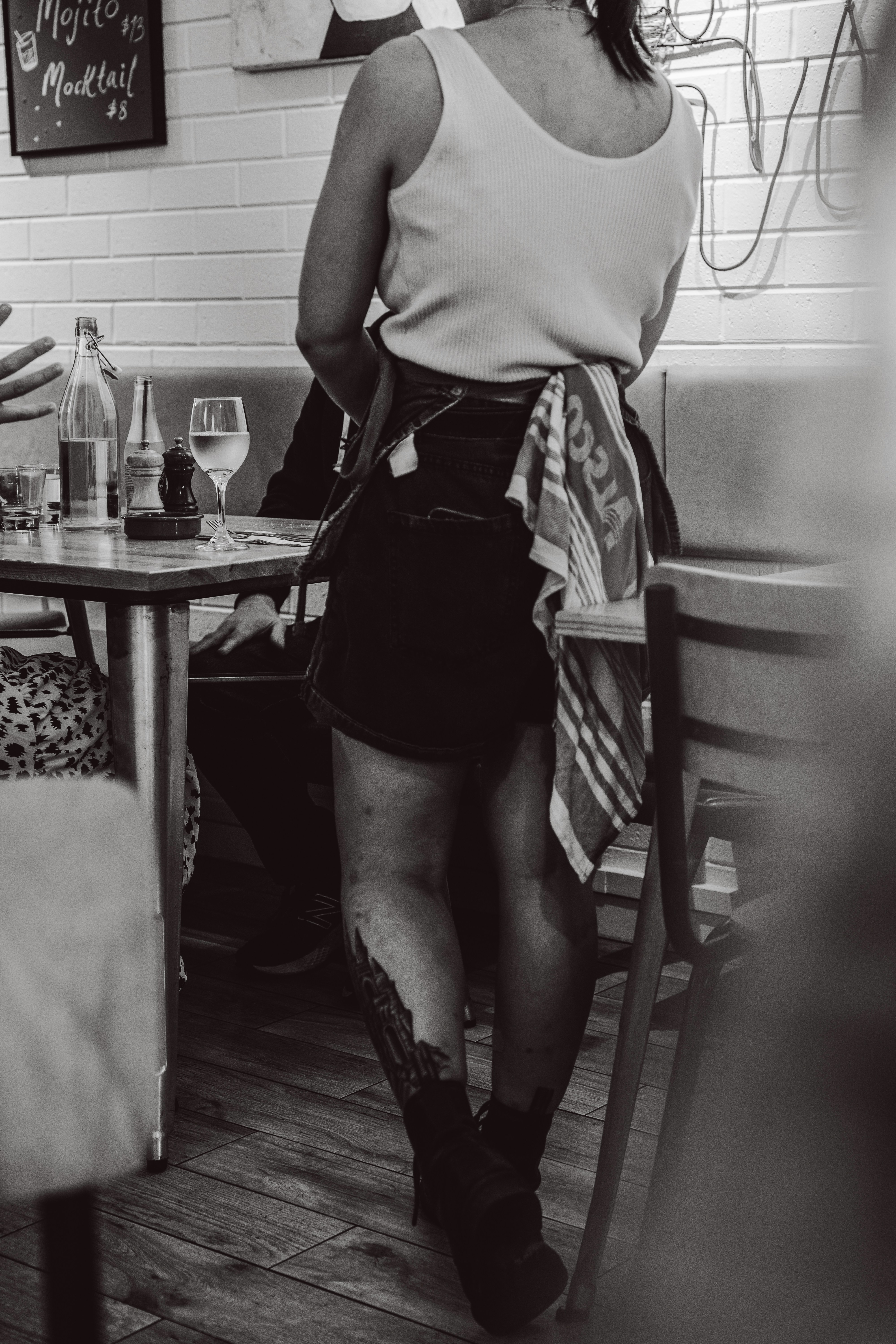
At this exact moment, Agent J——, carrying a tray full of beers in a tight black waitressing outfit, crosses the field of vision of Mr. MacArthur coming through the doorway and he pauses in the threshold letting a breeze inside while following her backside with just his eyes in that obvious way men continue to do forever. Miss Margaret, sitting across the room in her booth with her girlfriends, sees Agent J pass by the man at the open door, sees how absolutely perfect her figure is, immediately grows jealous of Agent J, and upset at the man at the door for ignoring her own beauty over that working bitch’s—which is what Miss Margaret thinks as Jules passes the beers out to a table in the middle of the room, bending over with requisite playgirl banter to hand the drinks to heavyset thirsty-looking men. Agent J looks over her shoulder at Mr. MacArthur and 100% destroys any chance Mr. MacArthur has of having sex with Miss Margaret as the look on his face is one Miss Margaret has never witnessed before and it frightens her because she thinks for an instant, _I will never have a man look at me that way_, and she presumes an in-bent cycle of self-deprecation in which she ends her own chances of getting laid because after seeing Jane’s fantastic backside strut away and puzzlingly out the front door of Uncle Ducky’s and into the street and the moving car that is actually a time machine hooked up to deliver Jules 86 years into the future, the man who is to seed the sperm of the most violent, misogynist, fuckup of all time, sees the average, wincing face of Miss Margaret and decides that that girl isn’t worth even a moment of his time because she isn’t as pretty as Jules or Jackie or whatever her name is, all he catches is a glimpse of her nameplate on her waitress’s uniform as her fantastic ass strides out of his sight forever.